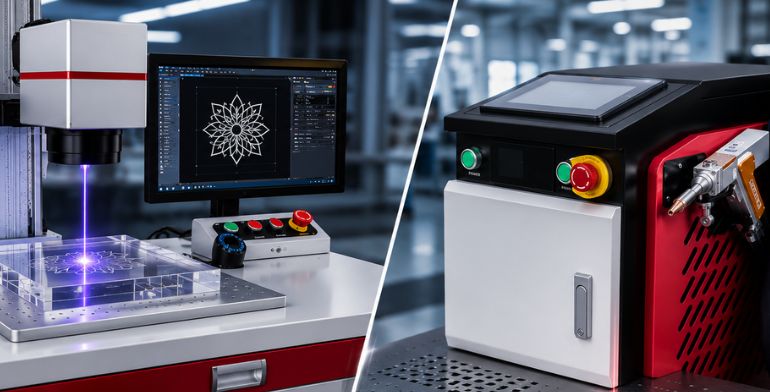
Industrial marking has come a long way. It’s not about branding a product or putting a serial number on it. There are many reasons manufacturers use marking systems today. Includes traceability, rules to follow, and quality control to prevent products and identify brands.
Choosing the wrong laser marking system affects the print quality, damages materials, slows down production lines, and quietly inflates your operating costs over time. Manufacturers need to know the strengths and limitations of each technology. Whether it’s delicate plastic components, medical devices, metal automotive parts, or engineering products, the right laser system enhances the consistency and supports your production goals.
This is why businesses searching for a Marking or engraving machine in Delhi often compare UV and fiber laser technologies before making the right decision.
This guide compares both technologies. It does so, from a manufacturing perspective.
1. Key Takeaways
- UV lasers are ideal for plastics, glass, medical components, and other heat-sensitive materials.
- Fibre lasers are used for metal marking, deep engraving, and high-volume production.
- UV laser marking produces very little heat impact, reducing the possibility of material deformation.
- Fibre laser systems improve the marking speeds and reduce the operating costs for metal applications
| Parameter | UV Laser Marking Machine | Fiber Laser Marking Machine |
|---|---|---|
| Wavelength | 355 nm | 1064 nm |
| Marking Method | Cold marking (photochemical) | Thermal marking |
| Material Compatibility | Plastic, glass, ceramics, stainless steel, silicon wafers/PCB, aluminium, brass | Plastic, ceramics, stainless steel, silicon wafers/PCB, aluminium, brass |
| Precision | Extremely high – ideal for micro-text, QR codes, barcodes on sensitive substrates | Moderately high – best suited for industrial identification and engraving |
| Marking Speed | Moderate – prioritises mark quality over throughput | Fast – suited for large-scale, high-volume environments |
| Heat Impact | Very low – safe for medical plastics, thin films, electronic components, sensitive packaging | Higher – generates more heat during the marking process |
| Deep Engraving Capability | Limited | Excellent – preferred for deep engraving applications |
| Operating Costs | Higher initial investment due to specialised optics; lower rejection rates justify cost over time | Generally lower for metal applications (high efficiency + rapid processing = lower cost per part) |
| Maintenance | Low: optical cleaning, lens inspection, cooling system checks | Low: known for long operational lifespan; same routine servicing applies |
| Typical Industries | Electronics, medical devices, plastic manufacturing, flexible packaging, pharmaceutical packaging | Automotive, metal fabrication, engineering components, aerospace, tool manufacturing |
Although UV and fiber lasers focus primarily on surface marking and engraving, a 3D Laser Engraving Machine in India is designed for curved, uneven, or complex surfaces printing.
These systems can dynamically adjust focus across varying heights, making them suitable for:
- Mold engraving
- Die marking
- Complex engineering components
- Customized industrial products
For standard industrial marking, UV and fiber lasers remain the most common choices. However, manufacturers working with intricate geometries may benefit from evaluating 3D laser engraving technology.
Local Buyer Considerations
Companies thinking about the evaluation of a laser marking solution should always seek local technical support, installation assistance, operator training, and after-sales service. Working with an experienced industrial solution provider can make the process of selecting and deploying a laser marking machine or laser engraving machine in Delhi much easier for manufacturers. Remember, the right machine may not be the most sophisticated in the room, but it will still give perfect marking quality, production efficiency, and long-term reliability for the application.
Conclusion
Every production line has a different demand. A medical device manufacturer and an automotive fabricator may both need laser marking, but the machines sitting in their facility should look nothing alike. UV laser technology protects sensitive materials and delivers precision that holds up under scrutiny. Fiber laser technology drives throughput on metal at costs that make sense at scale.
The question isn't which laser is better. It's which one is right for what you actually make.
If you're still working that out, Meditek's team has been doing exactly this since 1988. We're based in Delhi and available to walk through your application in person.
Get in touch with Meditek → Call us: +91 98115 00524 Email: info@meditekprintingsolutions.com Or visit us at Kirti Nagar Industrial Area, Delhi – 110 015